Healthcare is at a hinge point. Rapid advances in artificial intelligence, the mainstreaming of telemedicine, and a steady stream of technological innovations are reshaping how we diagnose, treat, and prevent disease. This isn’t a gentle evolution — it’s a structural shift with enormous upside and equally significant risks. Below is a clear-eyed look at where things are headed, what’s already changing, and what clinicians, educators, and policymakers should be doing next.
Two forces accelerated change: vast, cheaper data (electronic health records, wearables, imaging) and compute power that can turn that data into useful predictions. The result: tools that can spot disease earlier, deliver care remotely, and personalise treatment at scale. But technologies don’t automatically improve outcomes — they amplify whoever designs, deploys, or regulates them. That’s why a critical, practical approach is needed.
Why this matters now
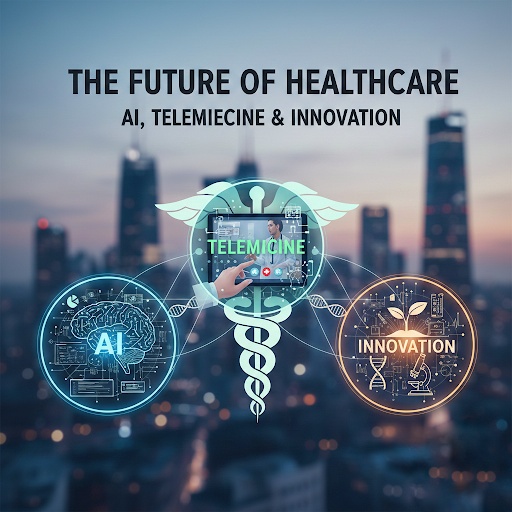
AI: from pattern recognition to clinical decision support
AI is no longer just a laboratory novelty. Its strengths are clear:
Diagnostics at scale. Machine learning models can detect patterns in imaging, ECGs, and pathology slides that are hard for humans to see. For routine screening tasks, AI can speed throughput and reduce missed findings.
Risk prediction and triage. Predictive models can flag patients at high risk of deterioration, enabling early interventions.
Workflow automation. Natural language processing can summarise notes, automate coding, and free clinicians from repetitive tasks.
But be blunt: the technology is not magic. Models are only as good as their data. Biases in training datasets produce biased outputs. Over-reliance on opaque models can deskill clinicians and create liability nightmares. The sensible path is explicit: use AI as decision support, not decision replacement; demand transparency, continuous validation, and prospective clinical trials showing improved patient-centered outcomes.
Telemedicine: access, convenience, and quality trade-offs
Telemedicine exploded because it removes barriers — geography, transport, missed work. It’s excellent for follow-ups, medication management, mental health care, and triage. Remote monitoring (wearables, home spirometers, glucometers) extends the clinician’s reach into daily life.
But telemedicine also reveals trade-offs:
Care fragmentation. Poorly integrated virtual visits can duplicate tests and fragment records.
Inequities. Broadband, device access, and digital literacy create new disparities.
Clinical limits. Some conditions still require hands-on assessment or in-person tests.
The realistic goal: hybrid models that combine remote convenience with structured in-person care when needed, supported by interoperable records and clear clinical pathways.
Innovation beyond AI and video
Health innovation also includes point-of-care diagnostics, gene therapies, minimally invasive devices, and logistics improvements (supply chains, cold storage, last-mile delivery). Low-cost sensors and modular diagnostics can decentralize care, letting community clinics and even homes detect and manage conditions earlier.
For resource-limited settings, the most impactful innovations will be those that lower the cost of essential care, simplify training, and reduce dependence on centralized infrastructure.
Ethics, privacy, and regulation — the non-negotiables
Technical capability will always outrun governance. Key areas that demand urgent attention:
Data governance. Patients must retain meaningful control, and consent models should be practical and enforceable.
Algorithmic accountability. Institutions should publish performance across demographic groups and allow independent audits.
Liability clarity. Who is responsible when an AI suggestion harms a patient — clinician, vendor, or hospital? Law and policy must catch up.
Security. Connected devices and cloud services expand attack surfaces; security must be baked in, not bolted on.
Regulators should aim for a balance: accelerate useful technologies while enforcing rigorous evidence and safety standards.
Workforce and education: preparing clinicians for a new toolbox
Technology changes the job; it shouldn’t replace the clinician’s judgment. Practical steps:
Curriculum overhaul. Integrate data literacy, interpretation of AI outputs, telemedicine skills, and digital professionalism into undergraduate and continuing education.
Interdisciplinary training. Clinicians should work with data scientists, ethicists, and engineers in real projects.
Focus on human skills. Communication, shared decision-making, and systems thinking become more valuable as routine tasks are automated.
For educators and clinical leaders, the priority is not to teach coding for its own sake, but to teach clinicians how to critically evaluate and safely apply new tools.
Business models and health systems: incentives matter
Innovation will follow payment structures. Fee-for-service tends to fragment care and reward volume; value-based models encourage integrated, preventive, and outcomes-focused solutions. Wherever possible, policies and incentives should align technology adoption with demonstrable improvements in outcomes and equity.
Practical recommendations (what organizations should do today)
- Pilot with measurement. Start small, measure patient outcomes, workflows, and equity impacts before scaling.
- Insist on interoperability. Choose tools that integrate with existing records to avoid fragmentation.
- Create governance boards. Include clinicians, patients, data scientists, and ethicists to review AI/telehealth deployments.
- Invest in workforce transition. Fund training, support clinicians during change, and protect against deskilling.
- Mandate transparency. Vendors must disclose training data characteristics, performance metrics, and limits.
The long view: a cautiously optimistic future